
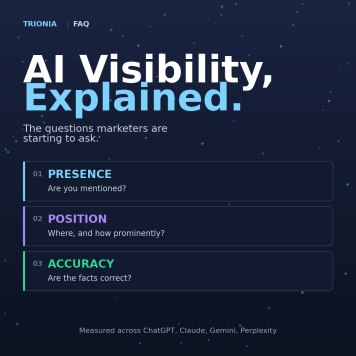
AI Visibility — FAQ
A two-part FAQ. Part 1 answers the questions clients and prospects ask about Trionia's AI Visibility tool. Part 2 explains the current state of the art in AI Visibility, AEO, and GEO — what's real, what's hype, and how the market is measured — with sources. Last updated June 2026. Market figures move fast; re-check sources before quoting.
Part 1 — About AI Visibility
What is AI Visibility?
Every night Trionia's AI Visibility tool asks the major AI assistants — ChatGPT, Claude, Gemini, and Perplexity — a set of real-world questions about your market, then measures how often you show up, where you rank against competitors, how you're described, and what the AI says about you. The results become a score out of 100 per assistant, tracked over time, with a clear list of what to fix.
What exactly does it measure?
Four things, which combine into your score:
- Mention rate — how often you appear when people ask AI about your category.
- Position — where you appear, and which competitors appear alongside or ahead of you.
- Sentiment — how positively the AI describes you (a low score usually means you're under-mentioned, not described negatively).
A secondary "depth" measure (how much detail the AI volunteers about you) is also reported, but kept out of the headline grade.
Which AI engines do you track?
ChatGPT, Claude, Gemini, and Perplexity, run nightly. These cover the large majority of AI-assistant usage. Coverage of additional engines (and Perplexity as an optional add-on) is handled through your plan.
Do you track Google AI Overviews?
Not in the current release — it's on the near-term roadmap. Google offers no official way to pull AI Overview results, so (like every tool in the market) it requires simulated browser-based collection rather than a clean data feed. We'd rather add it properly than report shaky numbers. See Part 2 for why AI Overviews data is inherently partial across all vendors.
What makes Trionia's tool different from other AI visibility tools?
The accuracy check. Almost every tool on the market tracks mentions, sentiment, and share-of-voice. Very few check whether the AI is telling the truth about you. We verify the factual claims AI makes about your brand against your own verified facts, and flag two kinds of problem: incorrect citations (often fixable — e.g., the AI is repeating an outdated source) and hallucinations (invented details). If your concern is "is AI saying wrong things about us," that's the gap most tools leave open. (See Part 2 for how rare this capability is.)
How do you check accuracy and catch hallucinations?
During setup we build a set of verified "facts" about your organization (pulled from your own website and editable by you). Each claim an AI makes is compared against those facts. Claims that match are confirmed; claims that conflict are flagged; claims with no matching fact are set aside as "unverified" (usually harmless, just not something we have a fact for). Real examples we've caught include a wrong tuition figure stated with confidence, a product incorrectly described as not available online, and an invented office location.
Where do the "facts" we're checked against come from?
From your own website during onboarding — then you review and edit them. The logic is simple: if a fact isn't published anywhere you control, it's hard to hold the AI to it. You stay in control of what counts as ground truth.
AI gives a different answer every time — how is this reliable?
That's exactly why we run it the way we do. Instead of asking once, we run many prompts across all the assistants, every night, and track your appearance rate and share of voice over time rather than a single "rank." Independent research confirms that exact AI rankings are essentially noise, but how often you appear across many runs is a stable, meaningful signal (see Part 2, "Why is AI visibility hard to measure?"). Our reporting is built around that reality.
How many prompts do you track?
Around 20 by default, organized by buyer-journey stage (awareness, consideration, decision) and audience. They're fully editable — swap, remove, or add your own — and you can track more on higher plans. Pricing scales with the number of prompts.
What's in the report?
A single, interactive report that includes: your headline score by assistant, trend over time, competitor comparison and share-of-voice, a query-by-query view of where you do and don't appear, a citations view showing which pages get referenced, the accuracy/validation section, key findings, recommendations, and a methodology section that spells out exactly how each score is calculated. It's fully customized to your brand colors.
How do I actually use the report?
Three ways: (1) establish a baseline for where you stand in AI today; (2) find the gaps — the prompts where competitors win and you're absent; (3) fix what's wrong — correct the inaccurate claims and prioritize the content and technical work that improves your standing. The report tells you where to focus; the work itself can run in parallel (e.g., a content piece and the supporting structured data at the same time).
What kind of recommendations does it give?
Evidence-based ones. The tactics with the strongest research support — adding statistics, citations, and quotes; earning brand mentions on third-party sources; structuring content so it's easy to extract; and clean structured data — are prioritized over speculative ones. Recommendations are increasingly assistant-specific, because Claude and ChatGPT behave differently from Gemini and Perplexity, so the right move depends on which assistants your audience actually uses. (Part 2 covers what's evidence-backed vs. hype, including the honest picture on llms.txt.)
Will my score actually improve if I act on this?
We're measuring that relationship directly — tracking how changes to content, structured data, and earned mentions correlate with movement in AI visibility over time. We're deliberately not in the business of "guaranteed #1 in AI" promises; AI visibility is new enough that the honest answer is that we measure rigorously, recommend what the evidence supports, and show you the trend.
If the tool tells me what to fix, why do I still need my agency?
The AI Visibility tool is the measurement layer — it tells you, precisely and continuously, where you stand and what's wrong. Acting on it (writing the content, fixing the structured data, running the digital-PR that earns mentions) is execution work that an agency does. The analogy is SEO tools: a platform can tell you what to improve, but most teams still rely on specialists to actually do it and to prioritize across everything else. The tool makes the agency's work sharper and more accountable; it doesn't replace it.
How is it priced?
The standard plan is $500/month per brand/program for nightly tracking of around 20 prompts. For budget-sensitive organizations we also offer one-off or quarterly audits at a lower cost, and a lower-frequency tier is planned for nonprofits and public institutions. Agencies get a referral arrangement and can white-label the reports for their clients. Pricing scales with the number of prompts and engines.
Can we do a one-time audit instead of a subscription?
Yes. A one-off audit gives you a snapshot baseline — useful for a board update, a brand-awareness benchmark, or a first look before committing to ongoing tracking.
How do we get started?
Onboarding is a short guided setup: enter your site, and the system pulls your brand details, suggests competitors, generates a starter set of prompts, and drafts your fact list — all of which you review and edit. From there it begins nightly tracking and your first report follows.
Part 2 — AI Visibility, AEO & GEO: State of the Market (2026)
This section is sourced from primary research and industry studies. Where a figure comes from a vendor "stat roundup" rather than an original audited study, it's marked as directional.
Terminology
What do AEO, GEO, AI Visibility, and LLM SEO actually mean?
They're overlapping labels for one goal: getting your brand surfaced, cited, and recommended inside AI answers rather than only in traditional search links.
- AI Visibility — the umbrella outcome: how often and how prominently your brand appears across AI answers.
- AEO (Answer Engine Optimization) — optimizing to be the cited answer in AI-powered answer features like Google AI Overviews and featured snippets.
- GEO (Generative Engine Optimization) — optimizing to be retrieved and cited by generative assistants like ChatGPT, Claude, Perplexity, and Gemini. The term was coined in a Princeton/Georgia Tech/Allen Institute paper at ACM SIGKDD 2024.
- LLM SEO / LLMO / AIO — loose synonyms for the same discipline.
The line between AEO and GEO is blurry and the two are often used interchangeably; the industry hasn't standardized on one term, with "AI visibility" emerging as the catch-all (Jasper, Wikipedia: GEO).
Why it matters
How big is AI search now?
ChatGPT reached roughly 800–900M weekly active users in early 2026, up from ~400M a year earlier (Omnibound). Directional query-share estimates put Google around 80% of queries, ChatGPT ~17%, and other AI/alt-search ~3% — though these splits come from vendor roundups, not a single audited source, so treat as directional (QuickSEO).
What's happening with "zero-click" search?
Zero-click rates hit record highs in 2025 — roughly 58–60% of US/EU searches ended without a click to an external site, and reportedly ~83% when an AI Overview was present. AI Overviews are reported to appear in ~25% of Google searches (up from ~13% in early 2025), with some publishers reporting 20–40% organic-traffic declines (Omnibound, Superlines). These are vendor-aggregated; confirm the underlying Pew/Bain/SparkToro figures before putting hard numbers in front of a client. The core point holds regardless of the exact percentage: more and more answers happen without a visit to your site.
Does AI traffic actually convert?
The recurring theme is "less volume, higher quality." Holiday-2025 reporting showed AI referral traffic to US retail growing several-hundred percent year-over-year and converting meaningfully better than non-AI traffic (Omnibound, Goodie). Exact figures vary by source and methodology.
How AI engines choose what to cite
How do AI answers decide which sources to use?
Modern AI search is increasingly "agentic RAG": a single question is broken into many sub-queries ("query fan-out"), passages are retrieved and scored for each, and the best are synthesized into one answer. Google's AI Mode uses a custom model built for fan-out (iPullRank on fan-out, Search Engine Land). Most retrieved pages are never cited, so being retrievable isn't enough — you have to be the passage worth quoting.
What content actually drives citations?
The peer-reviewed Princeton GEO study (10,000 queries) found the strongest levers were adding statistics, citing sources, and adding quotations, plus authoritative, fluent writing — boosting visibility in generative answers by up to ~40%. Keyword stuffing performed worse than doing nothing.
Do brand mentions matter more than backlinks?
Evidence says yes. Ahrefs studied ~75,000 brands and found unlinked brand mentions correlated most strongly with AI visibility (~0.66), while raw backlinks correlated lowest (~0.22) — roughly a 3× gap. A follow-up found YouTube mentions correlated even higher. These are correlations, not proof of causation, but the signal is consistent: earned mentions across third-party sources (Reddit, Wikipedia, YouTube, review sites, press) matter more than link-building alone.
The llms.txt question
Should we publish an llms.txt file?
The honest 2026 answer: probably not for AI-search visibility. llms.txt is a markdown index file proposed in 2024 to help AI agents navigate a site. The "it boosts AI visibility" framing was added later by the SEO industry on speculation, and the evidence is skeptical:
- Ahrefs (June 2026, 137K domains): of domains publishing llms.txt, 97% of those files got zero requests in a month — and the bots that did fetch them were mostly coding/agent tools, not AI-search crawlers.
- SE Ranking (300K domains): found no link between llms.txt and citation frequency.
- Google doesn't use it. John Mueller compared it to the discredited keywords meta tag, and Google's own AI-optimization guide says special files like llms.txt aren't needed.
The narrow exception is futureproofing for AI agents completing tasks on your site (navigation, transactions) — not visibility. Bottom line: low cost to publish, but don't expect AI-search lift, and don't let it crowd out the tactics that are evidence-backed.
Best practices
What's actually worth doing in 2026?
Evidence-backed, in rough priority:
- Increase factual density — statistics, named citations, direct quotes, authoritative voice (Princeton GEO).
- Earn brand mentions across Reddit, Wikipedia, YouTube, review sites, and press (Ahrefs).
- Structure content for extraction — clear, self-contained sections that answer one question well.
- Clean structured data (schema) — Organization, Product, Article, FAQ; helps AI verify and attribute claims (Digidop).
- Keep facts fresh — current pricing, dates, and details; AI favors recent, specific, verifiable sources.
Avoid: keyword stuffing and promotional fluff (both correlate negatively with citations). Treat single-vendor "do X for Y% lift" claims skeptically unless independently replicated (evidence review).
Measurement
Why is AI visibility so hard to measure?
Because AI output is non-deterministic. SparkToro's January 2026 study (Rand Fishkin, ~2,961 runs) found there's less than a 1-in-100 chance that two responses to the same prompt return the same list of brands, and roughly 1-in-1,000 that they match in the same order. Tracking your "rank" in ChatGPT is, in Fishkin's words, largely "baloney."
So what can you measure?
Appearance rate / share of voice across many prompts and repeated runs. Even a skeptic like Fishkin concluded that while exact rankings are noise, how often a brand shows up across dozens-to-hundreds of runs is a statistically meaningful "consideration-set" signal. The right metric for clients is "we appear in X% of relevant AI answers," not "we're #3 in ChatGPT." This is why credible tools (Trionia's AI Visibility tool included) run many prompts repeatedly and report rates and trends.
What else makes measurement messy?
- Prompt diversity — real users phrase questions very differently, so any fixed prompt set under-samples reality.
- No AI Overviews API — every vendor scrapes/simulates Google AI Overviews, and even the best detection is only ~68% reliable (Feb 2026 benchmark). All AIO data in this category is partial.
- Personalization — answers vary by account history, location, and device.
- Attribution gaps — AI answers often drive zero clicks, so influence happens with no analytics trail. Enterprise leaders tend to over-state their confidence here (Branch survey of 300 leaders).
The tool landscape
What tools exist, and what do they cost?
The market splits into mention/sentiment trackers (most of the field) and a small set that also verifies factual accuracy. Pricing as of June 2026 (re-verify before quoting — it changes often): Tool Engines tracked Notable for Entry price Profound Up to 10 (tiered) Enterprise leader; real-user "prompt volumes" panel $99/mo (ChatGPT only) → $399 → custom Peec AI 3 base + add-ons Europe/GDPR focus, agency workspaces ~€205 → €675/mo Otterly.AI 4 base + add-ons Cheapest with AI Overviews on every tier $29 → $489/mo Scrunch AI ~8, all tiers Crawler analytics; markets hallucination monitoring $250 → $500/mo (acq. by Sitecore) Goodie AI Up to 11 End-to-end AEO + revenue attribution $399/mo → custom Writesonic Up to 10 (Ent.) GEO + content generation + auto-fix "Action Center" $79 → $399/mo Trakkr All 8 on every paid plan Best low-cost coverage; genuine free tier Free → ~$100–500/mo Ahrefs Brand Radar 6 (no Claude) Ties AI visibility to Ahrefs' link/search data ~$828–1,148/mo (incl. base sub) Semrush AI Toolkit 5 (no Claude) Strong brand sentiment + recommendations $99/user/mo → bundles SE Ranking Google AIO/AI Mode + ChatGPT Shows exact source URLs Google pulled into AIO ~$52 → $489/mo HubSpot AI Search Grader 3 (no AIO) Free one-time diagnostic Free ($50/mo for monitoring) Bluefish AI 6 incl. Amazon Rufus Factual-accuracy verification leader (enterprise) Quote-only Sources: official pricing pages and 2025–26 third-party reviews including Trakkr reviews, Otterly, Semrush KB, HubSpot AEO Grader, Bluefish. Entry tiers are deliberately thin — typically 15–50 prompts and 1–3 engines; "all engines" usually means Enterprise.
Which tools actually check whether AI is accurate about a brand?
This is the market's clearest gap. Bluefish AI leads with a dedicated claim-by-claim verification module (enterprise, quote-only). Knowatoa does a lighter "truthfulness" check, and Scrunch markets hallucination monitoring (depth unconfirmed). Everyone else — Profound, Peec, Otterly, Goodie, Writesonic, Trakkr, HubSpot, Ahrefs, Semrush, SE Ranking — tracks mentions, sentiment, and share-of-voice but not factual correctness. For a brand whose worry is "is AI saying the wrong thing about us," accuracy verification is rare and largely absent below the enterprise tier — which is precisely where Trionia's AI Visibility tool focuses.
Which tools cover Google AI Overviews?
Most self-serve tools now do (Profound, Peec, Otterly, Scrunch, Goodie, Writesonic, Trakkr, Ahrefs, Semrush, SE Ranking) — but all via scraping/browser simulation, never an official API, because Google doesn't offer one. HubSpot's free grader does not cover live AI Overviews. Expect any AIO data, from any vendor, to be partial.
Sources are linked inline. The highest-confidence, primary research underpinning Part 2: the SparkToro non-determinism study, the Ahrefs llms.txt and brand-mentions studies, the Princeton SIGKDD GEO paper, and Google's own Mueller statements and AI-optimization guide. Traffic and market-share percentages are vendor-aggregated and directional — confirm primary sources before client use.
0 Comments: